On this page
Quick answer
Make a written plan with your supplier and clinician before you need it. Know how long each battery lasts, keep them charged, and tell your electric company you use a ventilator. Have a backup ready. For flights, call the airline early: it can ask for 48 hours’ notice.
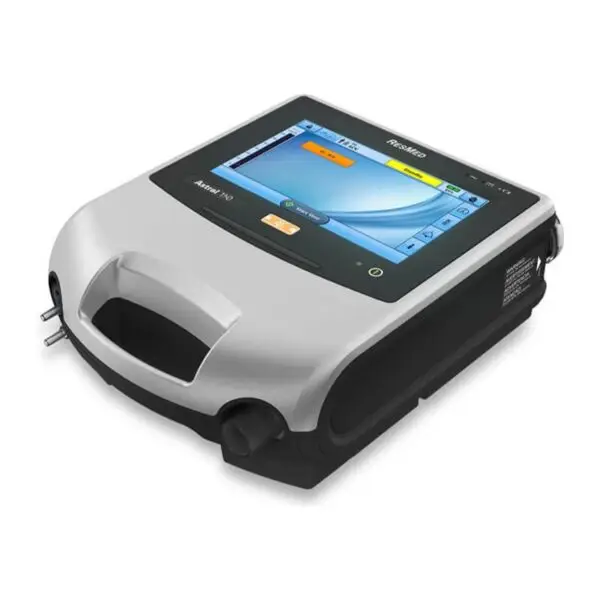
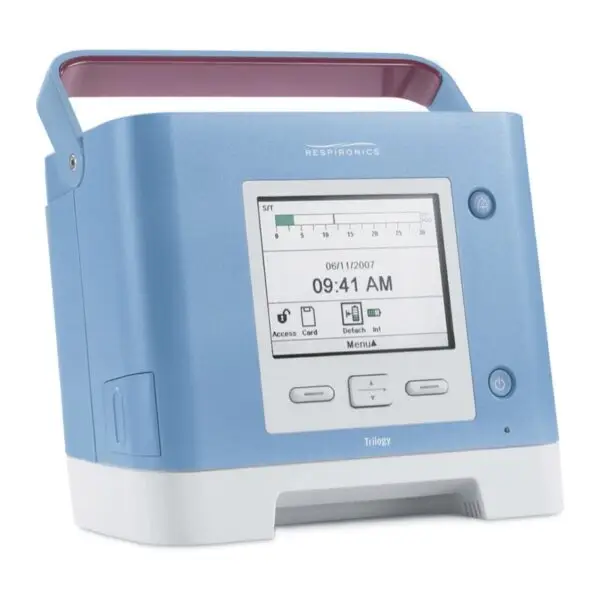
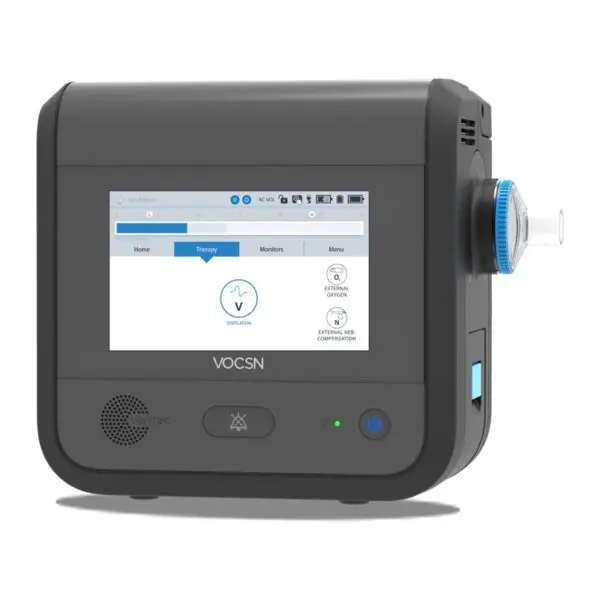
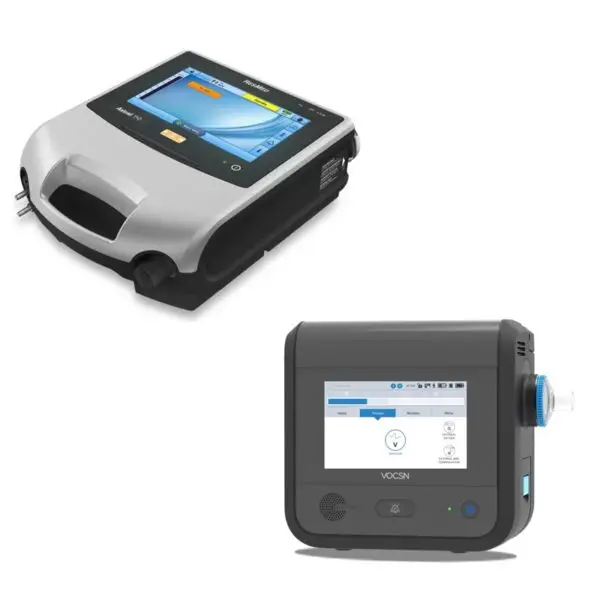
This guide covers ResMed Astral, Philips Trilogy and React Health VHome ventilators. It uses each maker’s guides plus government and utility pages. Your own supplier and clinician know your setup best, so build the plan with them.
Make a plan before you need it
Ready.gov says to talk with your medical provider about a power outage plan for medical devices. Then list everything at home that needs electricity.
Write these down and keep the list with the ventilator:
- The ventilator’s make, model and serial number.
- Which batteries you have, and how long each one lasts.
- Your supplier’s 24-hour phone number.
- Your clinician’s phone number.
- Your electric company’s outage line.
Ready.gov also says to keep extra batteries charged at all times.
Have a backup. The ResMed Astral and VOCSN manuals say people who depend on a ventilator should always have another way to ventilate ready, such as a backup ventilator or a manual resuscitator bag. Ask your supplier what your backup is and how to use it.
Know your batteries
This table shows what each maker’s own documents say. These are the makers’ numbers, often with new batteries and test conditions.
| Ventilator | Battery | What the maker says |
|---|---|---|
| ResMed Astral 100 or 150 | Internal | About 8 hours in typical use (new battery), but just over 4 hours in harder conditions. ResMed says it is not a main power source. |
| ResMed Astral 100 or 150 | Astral External Battery (up to 2) | Up to about 8 hours each in typical use, often less |
| Philips Trilogy 100 or 200 | Detachable | At least 3 hours under normal use |
| Philips Trilogy 100 or 200 | Respiratory Li-ion battery kit | More than 8 hours, in Philips’ test |
| Philips Trilogy Evo | Detachable | At least 7.5 hours under normal use, in Philips’ test |
| React Health VHome | Two removable | About 6 hours together, with new batteries |
| React Health VHome | Internal | About 2 hours. Only for power failures and swaps. |
Real run time is often shorter. It depends on your settings, leaks, temperature, charge level and battery age. Ask your supplier how long yours really lasts.
For the parts behind this table, see our guides to Astral, Trilogy and VHome supplies.
Tell your electric company
FDA says to let your electric company and fire department know you use a medical device that needs power, such as a ventilator.
Each company in Massachusetts and Rhode Island handles this differently:
| Company | Program | What it does |
|---|---|---|
| National Grid (Massachusetts) | Outage Life Support | Calls your home about outages so you can plan. Sign up with its Notice of Life-Sustaining Equipment form. Its phone number is 1-800-322-3223. |
| Eversource (Massachusetts) | Medical certification form | Your medical provider fills out the form, which asks about life support equipment at home. It is for shutoff protection and must be renewed. |
| Unitil (Massachusetts) | Life Support Customers | Your doctor fills out a Massachusetts medical form. Unitil says it will try to warn you about planned outages and bad weather. |
| Rhode Island Energy | Life-Sustaining Equipment Protection | Shutoff protection and calls before outages when possible. It has income limits, needs a medical form, and lasts 6 months unless extended. |
Don’t count on a list to bring your power back first. National Grid says plainly that its program doesn’t give you a higher priority for restoration. The other companies’ pages don’t promise it either. So plan as if the power could be out for a long time.
During a power outage
- Report it. Call your electric company’s outage line.
- Switch to batteries the way your plan says, and keep an eye on battery alarms.
- Know the warning signs. The Astral and the Trilogy 100 and 200 sound a low battery alarm when about 20 minutes are left on the last battery.
- Keep it dry. FDA says not to plug in a cord or device that is wet.
- Plan for a long outage. Unitil suggests arranging a place to go if you have to leave home. FDA suggests asking your local public health office about evacuation before bad weather arrives.
FDA says that if you depend on your device to keep you alive, seek emergency services right away.
Generators
- Ready.gov says generators and fuel go outdoors only, at least 20 feet from windows, doors and attached garages.
- FDA says never run a generator inside a basement, garage or other enclosed space.
- Ready.gov says to put carbon monoxide detectors with battery backup on every level of your home.
- Before you run the ventilator from a generator, FDA says to check the user instructions or call your supplier or the manufacturer.
Car power
Use only the maker’s own cable or adapter:
- Astral: the Astral DC adapter. ResMed says to start the car before you plug it in.
- Trilogy 100 and 200: Philips’ automotive DC power adapter.
- Trilogy Evo: Philips’ 12/24 V battery cable with car adaptor.
- VHome: the manual lists a 24 V wheelchair power cable, not a car cable. Ask your supplier about car power.
ResMed also says not to power the Astral from a power wheelchair’s battery.
When the power comes back
FDA says medical devices often reset to a default mode after a power cut. Ask your supplier to help you check that the ventilator is set up the way your clinician ordered. Don’t change settings on your own.
Traveling by car
- Use the maker’s in-use bag: the Astral Mobility Bag, the Trilogy in-use case or the VHome Carry Bag. ResMed says not to run the Astral inside its Carry Bag.
- Don’t leave batteries in a hot car. ResMed warns against heat such as behind a car window. The VOCSN manual says not to use or store its batteries in a vehicle in hot weather.
- Pack spare charged batteries, the power supply, a spare circuit and filters, and the user guide.
Flying with a ventilator
You can use it on board. A federal rule says U.S. airlines must let you use a ventilator in the cabin on planes with more than 19 seats. The ventilator needs a maker’s label that shows it meets FAA requirements.
- ResMed says the Astral meets the FAA’s RTCA/DO-160 standard for all phases of air travel.
- The VOCSN manual covers the VHome. It says units with an airplane symbol on the back label can be used on board aircraft. Check your VHome’s back label for that symbol.
- For a Trilogy, ask your supplier for Philips’ airline statement for your model.
Call the airline early. The rule lets airlines ask for:
- 48 hours’ notice, and check-in 1 hour before the general public.
- Enough fully charged batteries to last 150% of the longest expected flight time. The airline must tell you that flight time.
Batteries on the plane. The FAA says spare lithium batteries go in carry-on bags, never in checked bags. Protect them from damage and short circuits.
- Batteries up to 100 watt-hours (Wh) are allowed.
- Batteries from 101 to 160 Wh need the airline’s approval, and you can bring no more than two spares that size.
- Batteries over 160 Wh are not allowed.
ResMed lists the Astral External Battery at 97 Wh. For other batteries, read the label or ask your supplier.
It doesn’t count as a carry-on. The federal rule says airlines can’t count assistive devices, including ventilators, toward your carry-on limit.
Airport security. You can tell the TSA officer about your device out loud, with a TSA notification card, or with medical paperwork. TSA Cares can arrange extra help if you call at least 72 hours ahead: (855) 787-2227. ResMed suggests keeping a printed Astral user guide in the bag for security staff.
TSA’s page doesn’t name ventilators. For portable oxygen concentrators, it says to ask your doctor whether you can safely disconnect during screening.
When to call your supplier
Call the company that supplied your ventilator:
- Before storm season or any trip, to go over your plan.
- If a battery won’t charge or runs out sooner than expected.
- If an alarm sounds that you don’t understand.
- After a power outage, to check the ventilator.
- If you aren’t sure your backup is ready.
Sources
- Ready.gov. Power Outages. https://www.ready.gov/power-outages
- Ready.gov. People with Disabilities. https://www.ready.gov/disability
- U.S. Food and Drug Administration. FDA Offers Tips about Medical Devices and Natural Disasters. https://www.fda.gov/medical-devices/emergency-situations-medical-devices/fda-offers-tips-about-medical-devices-and-natural-disasters
- National Grid. Life Sustaining Equipment (Massachusetts). https://www.nationalgridus.com/MA-Home/Outage-Central/Life-Sustaining-Equipment
- National Grid. Massachusetts Electric Outage Life Support Form. https://www.nationalgridus.com/Form/MA-Electric-Outage-Life-Support-Form
- Eversource. Medical Certification of Illness Form for Residential Customers in Massachusetts. https://www.eversource.com/docs/my-account/ema-medical-certification-of-illness-form.pdf?sfvrsn=50a05fed_2
- Eversource. Medical Web Portal and Protection. https://www.eversource.com/residential/account-billing/payment-assistance/medical-web-portal-protection
- Unitil. Life Support Customers. https://unitil.com/outages-emergencies/life-support-customers
- Rhode Island Energy. Life-Sustaining Equipment Protection. https://www.rienergy.com/site/ways-to-save/assistance-programs/shut-off-protections/life-sustaining-equipment-protection
- U.S. Department of Transportation. 14 CFR 382.133 (respiration devices in the cabin). https://www.ecfr.gov/current/title-14/chapter-II/subchapter-A/part-382/subpart-J/section-382.133
- U.S. Department of Transportation. 14 CFR 382.27 (advance notice). https://www.ecfr.gov/current/title-14/chapter-II/subchapter-A/part-382/subpart-C/section-382.27
- U.S. Department of Transportation. 14 CFR 382.121 (assistive devices in the cabin). https://www.ecfr.gov/current/title-14/chapter-II/subchapter-A/part-382/subpart-H/section-382.121
- Federal Aviation Administration. PackSafe: Portable Electronic Devices Containing Batteries. https://www.faa.gov/hazmat/packsafe/portable-electronic-devices-with-batteries
- Federal Aviation Administration. Airline Passengers and Batteries: Frequently Asked Questions. https://www.faa.gov/hazmat/packsafe/resources/airline-passengers-batteries
- Transportation Security Administration. Disabilities and Medical Conditions. https://www.tsa.gov/travel/tsa-cares/disabilities-and-medical-conditions
- Transportation Security Administration. Passenger Support (TSA Cares). https://www.tsa.gov/travel/passenger-support
- ResMed. Astral 100 / Astral 150 User Guide (278626/1, 2022-04, Americas edition). https://document.resmed.com/documents/products/machine/astral-series/user-guide/astral-100-150_user-guide_amer_mul.pdf
- ResMed. Astral External Battery User Guide (278699/1, 2024-09). https://document.resmed.com/documents/products/accessory/astral-external-battery/user-guide/278699_astral-external-battery_user-guide_row_multi.pdf
- ResMed. Astral DC/DC Adapter User Guide (278653/1, 2022-06). https://document.resmed.com/documents/products/accessory/astral-dc-dc-adapter/astral-dc-adapter_user-guide_glo_mul.pdf
- Philips Respironics. Trilogy Accessory Guide (1153629 R01, 2023). https://www.documents.philips.com/assets/Instruction%20for%20Use/20230816/1fb95d1f07514ca2a709b060014769c5.pdf?feed=ifu_docs_feed
- Philips Respironics. Trilogy Instructions for Use Addendum (U.S. edition). https://www.documents.philips.com/assets/Instruction%20for%20Use/20220805/a053a3aa85c14133b6feaee800fe7642.pdf?feed=ifu_docs_feed
- Philips Respironics. Accessory Guide, Trilogy Evo (1143741 R05). https://www.documents.philips.com/assets/20191022/994bbcf2b9bd45de8f1baaee00dfa0da.pdf
- Ventec Life Systems (React Health). VOCSN Series Ventilator Portfolio Clinical and Technical Manual (LBL-00001-001, Rev AE). https://www.reacthealth.com/uploads/userfiles/files/documents/LBL-00001-001-AE%20vocsn_clinical_technical_manual_software_v4-06%20-%205-06%20AE.pdf